How can a PCB disassembly machine disassemble the components on a circuit board?
Printed circuit boards (PCBs) are everywhere—smartphones, appliances, EV chargers, medical devices, industrial controllers. But what happens when these electronics reach the end of their life? How do recyclers safely remove thousands of tiny components without damaging valuable materials such as gold-plated connectors, copper traces, IC chips, and aluminum capacitors?
Enter the PCB disassembly machine, a powerful solution designed to separate components from PCBs quickly, cleanly, and with high recovery rates. With global e-waste projected to reach 82 million tons by 2030, automated PCB disassembly has become essential for recycling facilities, metal recovery plants, and environmental engineering companies.
How PCB Disassembly Machines Disassemble Components
1. Pre-processing: Feeding and Sorting
Before disassembly begins, the PCB board undergoes the following processes:
- Manual or automated sorting (motherboard, TV motherboard, mobile phone PCB, computer PCB)
- Cleaning and inspection, removing batteries, cables, or hazardous components
- Size reduction (optional), suitable for oversized circuit boards
This ensures stable feeding, optimal heating, and higher metal recovery rates.
2. Controlled Heating: Softening Solder Layers
Heating is the core of PCB disassembly.
Most machines use:
- Hot air heating system
- Infrared heating chamber
- Conductive heating
The PCB board is heated to 260–320°C, sufficient to melt the solder joints without burning the circuit board. This temperature range is crucial for the following reasons:
- The solder melting point is approximately 183–220°C.
- Components can be easily removed after 260°C.
- The copper layer will not oxidize.
- The sealed chamber minimizes the generation of toxic fumes.
- Advanced equipment includes:
- Temperature sensors
- Automatic feedback control
- Adjustable heating zone
This ensures uniform heating, prevents localized overheating, and improves component recovery rates.
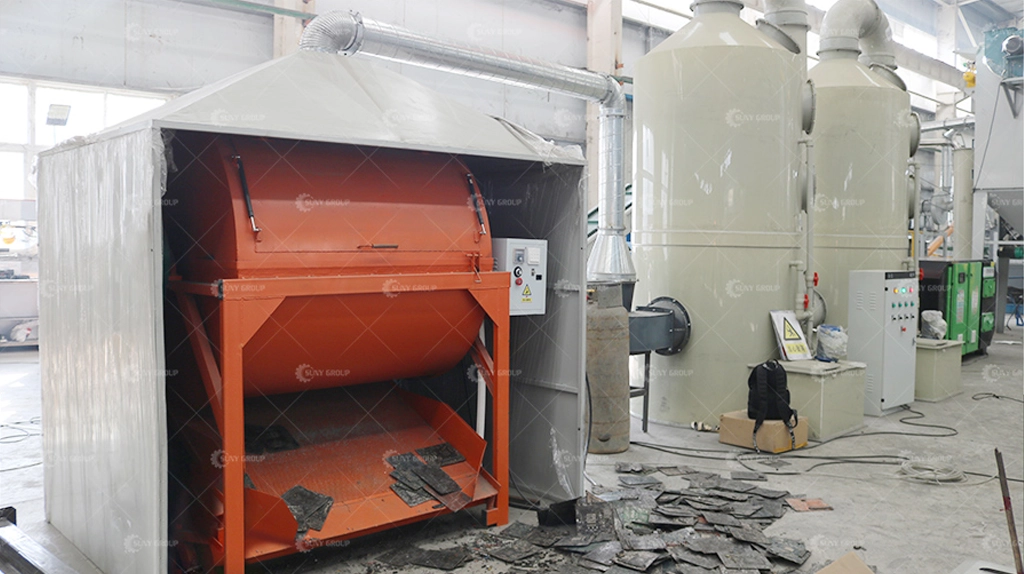
PCB Dismantling Machine structure
3. Vibration and shock mechanisms: facilitating component removal
While the solder softens, the PCB is vibrated.
Within the vibration chamber, the equipment applies:
- High-frequency vibration
- Vertical impact force
- Oscillation and shaking
This allows resistors, capacitors, integrated circuits, LEDs, chips, and even fine-pitch components to be cleanly and efficiently removed.
Vibration Principle:
✔ Loose solder joints become brittle.
✔ Components detach without external force.
✔ No damage to copper pads.
✔ Faster processing speed (300–500 kg/hour for large models).
4. Mechanical Separation and Screening
After components detach, the system sorts them according to size and category:
- Large components → MOSFETs, heat sinks, transformers
- Medium components → Capacitors, integrated circuit chips, resistors
- Small components → SMD chips, miniature capacitors
- A magnetic separator can be added to remove ferrous parts.
This step improves recycling purity and prepares the system for downstream recycling (e.g., integrated circuit chip unpacking or precious metal extraction).
A PCB disassembly machine is more than a recycling tool—it’s a high-efficiency, eco-friendly, profit-boosting system that transforms electronic waste into valuable resources. By combining precision heating, vibration separation, and advanced screening, it removes components cleanly and safely while boosting your recovery rates.