Dry vs. Wet PCB Grinding: Which is Better for Copper Liberation & E-Waste Recovery?
In the commercial e-waste recycling industry, extracting high-purity copper and precious metals from printed circuit boards (PCBs) is governed by a single, critical engineering prerequisite: complete mechanical liberation.
Because waste circuit boards are tightly bonded composites consisting of conductive copper foils, woven glass fiber (FR-4), and brominated epoxy resins, physical separation cannot occur until these layers are cleanly dissociated. Achieving this threshold requires fine milling down to a targeted fraction—typically between 0.3 mm and 1.2 mm (approx. 16 to 50 mesh).
When configuring a continuous 1 to 2 TPH (tons per hour) processing plant, recyclers often debate two main operational philosophies: wet milling paired with gravity concentration (Wilfley shaking tables) versus a complete dry physical recovery line utilizing airflow and electrostatic separation.
Which approach delivers the highest recovery rates, regulatory peace of mind, and commercial return on investment? Let’s evaluate both processes across operational, metallurgical, and economic metrics.
1. The Challenge of PCB Fine Milling: Temperature, Slime, and Liberation
To understand why wet systems were historically deployed, one must look at the mechanical behavior of scrap circuit boards during comminution:
- Thermal Sensitivity (Resin Softening): Under continuous mechanical friction, epoxy resins heat up rapidly. If chamber temperatures surpass 80°C to 100°C, the plastics soften and smear across the copper surfaces, mechanically locking metal particles inside a plastic matrix and blinding screens.
- Over-Grinding & “Copper Slime”: If ground too aggressively (< 0.1 mm), copper transforms into micro-flakes. In wet systems, these ultrafine particles form a colloidal suspension (“copper slime”) that fails to settle on gravity shaking tables and washes out with process discharge.
- Liberation Threshold: If material remains coarser than 1.5 mm, composite laminates remain physically interlocked, leading to poor metal grade and high non-metallic contamination downstream.
Historically, wet hammer mills were selected because continuous water flushing provides immediate chamber cooling and directly creates a wet pulp slurry for shaking tables. However, modern environmental regulations and operating costs have shifted the industry standard toward fully enclosed dry systems.
2. Dry vs. Wet PCB Recycling: Direct Engineering Comparison
| Evaluation Metric | Wet Milling & Gravity Shaking Table | Complete Dry Physical Recycling Plant |
|---|---|---|
| Cooling & Thermal Control | Water-flushed chamber prevents plastic burning. | Water-jacketed milling chamber + negative-pressure air cooling keep internal temperatures safely below 60°C. |
| Target Particle Sizing | 0.3 – 1.5 mm; produces high volumes of unrecoverable wet slimes. | 0.3 – 1.2 mm; strictly maintained via closed-loop pneumatic cyclonic classification. |
| Separation Mechanism | Single-stage wet gravity differential (Wilfley tables). | Dual-stage dry sorting: Airflow density separation followed by high-tension electrostatic purification. |
| Separation Efficiency | 90% – 94% on coarse fractions; ineffective on < 0.3 mm particles. | ≥ 99% copper purity & recovery rate across coarse, fine, and superfine fractions. |
| Environmental Permitting | High water footprint; mandates continuous industrial wastewater treatment (WWTP). | Zero wastewater discharge; 100% physical dry processing. |
| Secondary Processing | Wet copper sludge requires mechanical dewatering and thermal drying before smelting. | Discharges dry, commercial-grade copper powder ready for immediate packing and sale. |
| Fine Dust & Metal Capture | Micro-gold/copper flakes easily wash away in suspension basins. | Dual pulse-jet baghouse collectors capture 100% of micro-particulates under negative pressure. |
3. The Hidden Operational Liabilities of Wet Processing
While a wet mill dampens dust and cools grinding plates, it introduces severe bottlenecks throughout the rest of the facility:
Metal Loss in Suspended Runoff
Gravity shaking tables rely on the density differential between copper (ρ ≈ 8.9 g/cm³) and resin/fiberglass (ρ ≈ 1.8 g/cm³). However, in the presence of turbulent water films, particles smaller than 0.2 mm lose settling velocity and remain suspended. These fine copper particles and micro-gold flakes escape into settling ponds or get trapped in filter press cakes, eroding plant profit margins.
Heavy Wastewater Treatment Capex & Compliance Risks
Process water that contacts pulverized circuit boards absorbs heavy metals (lead, tin, copper) and halogenated flame retardants. Discharging this effluent without complex chemical precipitation, flocculation, and filtration units is illegal in most jurisdictions. Building and maintaining a dedicated wastewater treatment plant (WWTP) adds massive capital expenditure and ongoing chemical costs.
High Thermal Drying Penalties
Secondary smelters and metal refiners purchase dry copper concentrates, not wet pulp. Converting wet shaking table concentrates into saleable product requires continuous rotary or flash dryers, consuming substantial fuel or electrical energy every operating hour.
4. Inside a Commercial Dry Recovery Plant: From Raw Boards to 99% Pure Copper
Modern dry physical plants eliminate environmental and drying liabilities by combining multi-stage comminution with sequential density and electrical separation:
[Raw Scrap PCB Scrap]
           │
           ▼
[Double Shaft Shredder] ────────> Primary coarse shredding (10 - 30 mm)
           │
           ▼
[Hammer Crusher] ───────────────> Secondary reduction (< 2.5 mm)
           │
           ▼
[Fine Grinding Machine] ────────> Water-jacketed/air-cooled liberation (0.3 - 1.2 mm)
           │
           ▼
[Airflow Separator] ────────────> Stage 1: Bulk specific-gravity separation
           │
     (Middlings & Fines)
           ▼
[Electrostatic Separator] ──────> Stage 2: High-voltage conductivity purification
           │
    ┌──────┴────────────────────────┐
    ▼                               ▼
Dry Copper Powder              Resin & Fiberglass Powder
(≥99% Purity, Ready to Pack)   (Dry composite filler)
           │
    (Fully Enclosed Line) ──────> [Pulse Dust Collectors] Continuous clean air exhaust
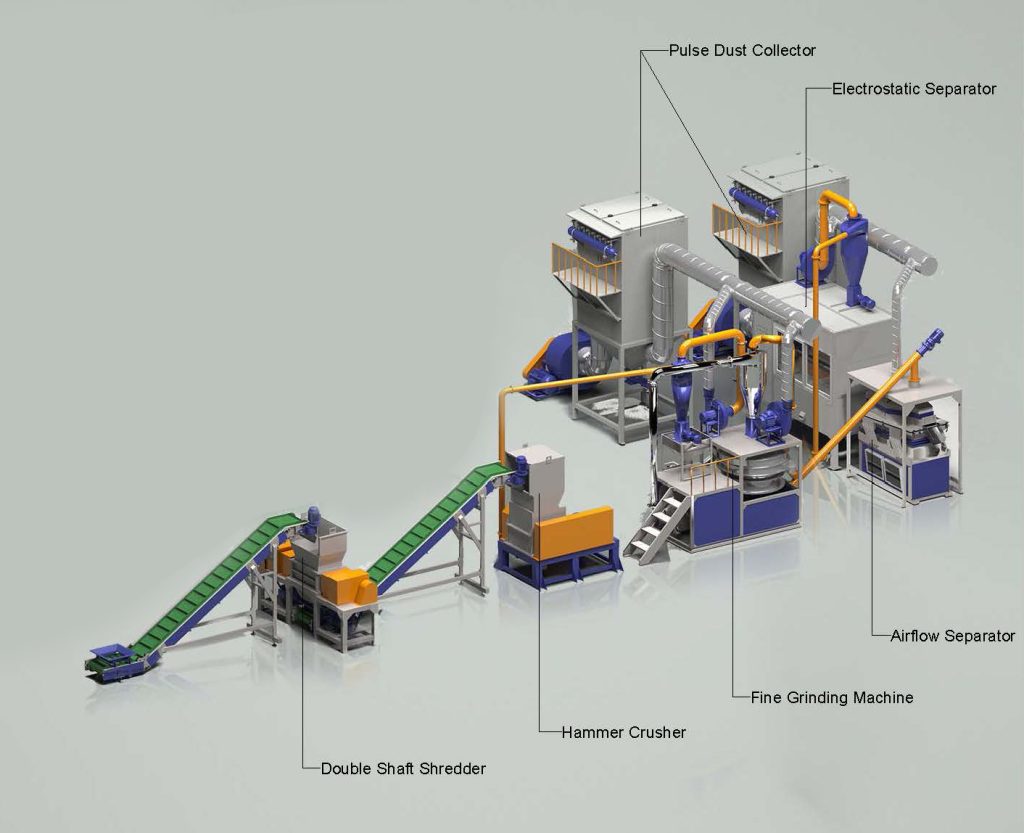
Flow diagram of a commercial 1.5–2 TPH dry PCB recycling line featuring dual-stage airflow and electrostatic recovery.
1. Multi-Stage Size Reduction & Temperature Management
Raw circuit boards are first processed through a slow-speed, high-torque Double Shaft Shredder to strip structural rigidity without generating dust. A secondary Hammer Crusher reduces the material to < 2.5 mm, liberating large surface components.
The material then enters a dedicated Fine Grinding Machine. Equipped with a water-cooled outer jacket and a high-velocity induced draft fan, the grinding chamber operates continuously below 60°C. Material is rapidly evacuated the instant it reaches the 0.3 – 1.2 mm liberation threshold, eliminating internal friction and preventing plastic melting.
2. Primary Sorting: Airflow Separator (Air Table)
Instead of a wet Wilfley table, liberated material flows directly onto an Airflow Separator. Using a combination of upward fluidizing airflow and eccentric deck oscillation, this unit stratifies particles strictly by density. It rapidly extracts over 85% of bulk copper granules and disposes of coarse, non-metallic fiberglass without adding a single drop of water.
3. Secondary Purification: High-Tension Electrostatic Separator
The middlings and superfine powders discharged from the airflow table proceed to a High-Tension Electrostatic Separator. Operating at high DC voltage, the unit differentiates particles by their surface electrical conductivity:
- Conductive copper particles quickly shed their charge upon touching the grounded separation roll and are thrown into the metal bin.
- Non-conductive resin and glass fibers retain their electrostatic charge, remain pinned to the rotating drum, and are brushed off into the tailings hopper.
This dry electrostatic stage reliably captures fine metallic particles down to 0.075 mm (200 mesh), achieving an overall metal recovery rate of ≥ 99%.
4. Total Environmental Containment: Pulse Dust Collection
All crushing, grinding, screening, and pneumatic conveying points are interconnected under negative air pressure directed into industrial Pulse Jet Dust Collectors. Filtered exhaust easily satisfies local particulate air emission standards, creating a completely dry, dust-free workplace without hazardous wastewater.
Conclusion: Dry Processing Delivers Superior ROI
While wet hammer mills were once considered an accessible method for controlling grinding heat, the ongoing liabilities of wastewater compliance, metal loss in slimes, and post-drying expenses make them an inefficient choice for modern e-waste plants.
By coupling controlled air-cooled fine grinding with staged airflow and high-tension electrostatic sorting, commercial dry recycling plants achieve complete copper liberation, recover over 99% of valuable metals, and produce dry, immediately saleable copper powder with zero effluent.
Optimize Your PCB Liberation & Separation Line
Planning a continuous 1.5–2 TPH e-waste processing facility or looking to replace an inefficient wet table setup? Contact our application engineering team to access:
- Detailed particle liberation curves and equipment capacity models.
- Hardfacing rotor alloy specifications for extended service life.
- Complete turn-key dry physical circuit board recycling line layouts.