How do circuit board recycling equipment separate out the copper?
Inside every discarded circuit board lies a hidden treasure: copper. From smartphones and laptops to industrial control panels, printed circuit boards (PCBs) are packed with valuable metals—especially copper, which makes up 15–30% of a typical PCB by weight.
But here’s the challenge: copper is tightly bonded with plastics, resins, fiberglass, and other metals. Simply shredding e-waste isn’t enough. That’s where circuit board recycling equipment steps in, using smart mechanical and physical separation technologies to recover clean, high-purity copper efficiently and profitably.
How Do Circuit Board Recycling Equipment Separate Out the Copper?
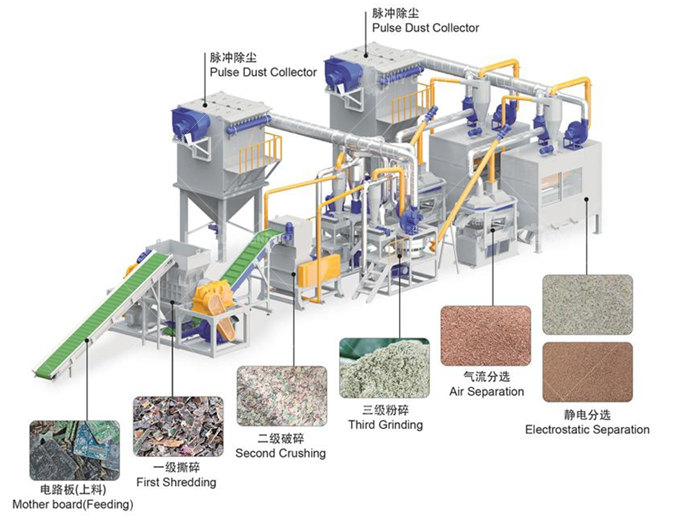
1. Crushing and Size Reduction: The First Critical Step
The copper separation process always starts with controlled crushing.
Circuit boards are fed into primary shredders or crushers
Boards are reduced into small particles (usually 5–20 mm)
This step liberates copper from resin and fiberglass layers
💡 Why it matters: Proper size reduction increases the exposure of copper, making downstream separation far more efficient.
2. Secondary Grinding: Liberating Copper Completely
After coarse crushing, material enters hammer mills or fine grinders.
Particles are further reduced into powder-like mixtures
Copper foils and wires detach from non-metal materials
Over-grinding is avoided to prevent copper dust loss
3. Air Separation: Removing Light Non-Metal Materials
Now comes the first real separation phase: air classification.
Airflow lifts lightweight materials like:
- Resin powder
- Fiberglass dust
- Plastics
Heavier copper particles fall due to gravity
✨ Result: A denser, metal-rich fraction with significantly higher copper content.
4. Gravity Separation: Let Physics Do the Work
Next, gravity-based machines take over.
Common equipment includes:
- Vibrating gravity tables
- Shaking tables
- Zig-zag separators
- Copper is much heavier than non-metals:
- Copper density: 8.96 g/cm³
- Fiberglass/plastics: 1.5–2.5 g/cm³
This density difference allows:
- Copper to move in one direction
- Non-metals to migrate elsewhere
🔑 Key takeaway: Gravity separation is one of the most cost-effective and chemical-free copper recovery methods.
5. Electrostatic Separation: High-Precision Copper Sorting
For high-purity results, electrostatic separators are used.
Here’s how they work:
- Materials pass through a high-voltage electric field
- Conductive copper discharges quickly and jumps toward the electrode
- Non-conductive materials fall straight down
⚡ Why it’s powerful: Electrostatic separation can push copper purity to 98–99%, ideal for resale or smelting.
6. Final Refinement and Collection
At the end of the line:
- Copper granules or powder are collected
- Non-metal residues are stored or reused (e.g., as fillers)
- Dust collection systems ensure safe, clean operation
♻️ Modern systems achieve copper recovery rates of 97–99% with minimal environmental impact.
Frequently Asked Questions (FAQ)
Is chemical processing required to separate copper from PCBs?
No. Modern circuit board recycling equipment relies on mechanical and physical separation, avoiding harmful chemicals and wastewater.
What purity level can recycled copper reach?
High-quality recycling lines can achieve 98% or higher copper purity, suitable for direct sale or further refining.
Can all types of circuit boards be processed?
Yes. Equipment can handle:
- Consumer electronics PCBs
- Industrial control boards
- Communication boards
- Automotive electronics
Adjustments in crushing size and separation parameters optimize results.
Is copper recycling from PCBs profitable?
Absolutely. With copper prices remaining strong, PCB recycling offers high ROI, especially when paired with aluminum and precious metal recovery.
Is the process environmentally friendly?
Yes. Mechanical separation:
- Produces no toxic wastewater
- Generates low emissions
- Reduces landfill pressure
It’s one of the greenest e-waste recycling solutions available today.
So, how do circuit board recycling equipment separate out the copper?
Through a smart combination of crushing, air separation, gravity separation, electrostatic sorting, modern systems transform complex electronic waste into high-value copper with incredible efficiency.
If you’re serious about e-waste recycling, copper recovery isn’t optional—it’s the core profit driver. And with today’s advanced equipment, it’s cleaner, faster, and more profitable than ever.