
AI E-Waste Sorting Machine: Automated Component Sorting in 4 Steps
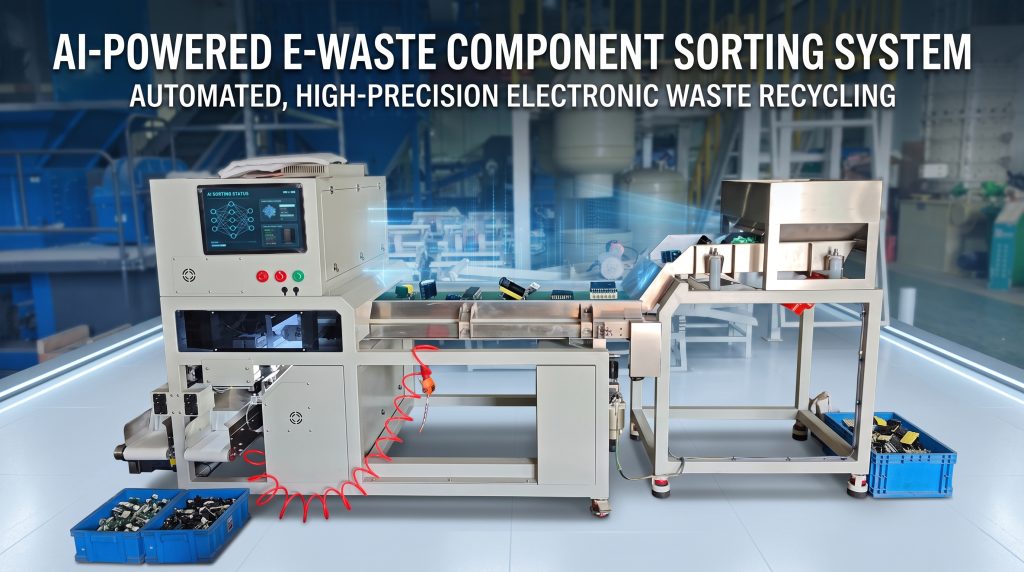
AI E-Waste Sorting Machine is designed to improve the sorting of valuable electronic components recovered from waste electrical and electronic equipment. By combining visual recognition, AI-based identification, and automatic robotic picking, the system can identify and separate different types of electronic components with less reliance on manual sorting.
Electronic waste contains a mixture of metals, plastics, circuit boards, and numerous small electronic components. According to the Global E-waste Monitor 2024, approximately 62 million tonnes of e-waste were generated globally in 2022, while only 22.3% was documented as formally collected and recycled.
For recycling companies processing large quantities of e-waste, automatic identification and sorting can therefore become an important part of a modern e-waste recycling line.
What Is an AI E-Waste Sorting Machine?
An AI E-Waste Sorting Machine is an automated sorting system that uses a vision system and artificial intelligence algorithms to recognize different objects in a mixed material stream.
After e-waste is dismantled, many small components may remain mixed together. These components can vary significantly in size, shape, color, and appearance. Typical materials include:
- Capacitors
- Inductors
- Electronic chips
- Connectors
- Sockets
- Other electronic components
Instead of depending entirely on workers to manually identify each component, the AI sorting system analyzes the material on the conveyor and determines the category of each recognized object.
The robotic sorting mechanism then picks or diverts the identified components into their corresponding collection areas.
This creates an automated workflow from material feeding and visual recognition to component separation and collection.
How Does the AI E-Waste Sorting Machine Work?
The sorting process can generally be divided into several stages.
1. E-Waste Feeding
Dismantled electronic waste is continuously fed into the sorting system. The upstream dismantling process should remove or open larger components so that smaller electronic parts can be exposed for further identification.
The feeding system helps distribute the material across the working area and provides a stable flow for the vision system.
2. AI Visual Recognition
A high-speed vision system captures information about the objects moving through the sorting area.
Depending on the configured sorting application, the system can analyze characteristics such as:
- Shape
- Size
- Position
- Appearance
- Color
- Component type
The AI recognition system then compares the detected characteristics with predefined categories.
This allows the machine to distinguish different electronic components in a mixed material stream.
3. Automatic Robotic Picking
After a component has been identified, the control system determines its position and sends the corresponding sorting instruction to the robotic mechanism.
The robotic arm then picks the target component and places or diverts it into the appropriate collection area.
The process can continue automatically as new materials enter the sorting zone.
4. Separate Collection
Different categories of electronic components can be collected separately.
For example, capacitors, inductors, chips, connectors, and other selected components can be directed into different containers according to the sorting requirements.
The separated materials can then be sent to subsequent recycling, refining, recovery, or resale processes.
Watch the AI e-waste sorting process: The video below shows how electronic components can be identified and automatically separated after dismantling.
Processing Capacity of the AI E-Waste Sorting Machine
The processing capacity of an AI E-Waste Sorting Machine depends on the equipment configuration and the characteristics of the incoming material.
For this type of application, a processing capacity of approximately 200–300 kg/h can be used as a reference. Actual capacity may vary according to:
- Composition of the e-waste
- Component size
- Material feeding density
- Number of sorting categories
- Recognition requirements
- Robotic picking frequency
- Upstream dismantling efficiency
Therefore, capacity should be determined according to the customer’s actual material and required sorting categories rather than simply selecting a machine based on the highest theoretical output.
For example, an AI sorting machine can be integrated with a PCB dismantling machine with a capacity of approximately 500 kg/h. The dismantling machine releases electronic components from the incoming material, while the AI sorting system performs subsequent identification and separation.
This creates a continuous process:
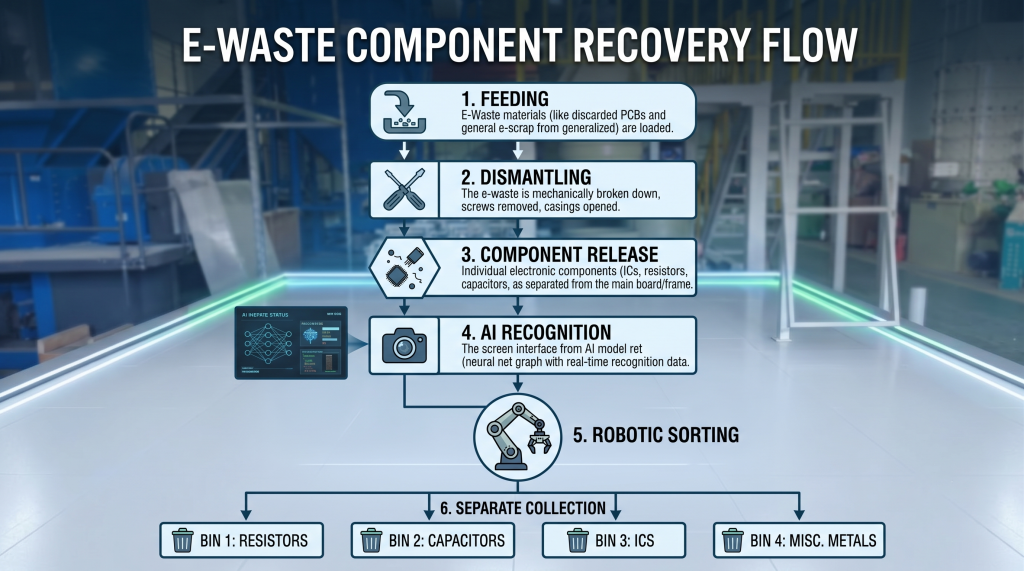
E-Waste Feeding → Dismantling → Component Release → AI Recognition → Robotic Sorting → Separate Collection
Why Use AI for Electronic Component Sorting?
Traditional manual sorting can be suitable for small quantities, but it becomes more difficult to maintain stable sorting efficiency when material volumes increase.
An AI E-Waste Sorting Machine can provide several potential advantages.For high-volume applications, an AI E-Waste Sorting Machine can also be integrated into a continuous e-waste recycling line.
Reduced Manual Sorting Work
Workers do not need to manually identify every component in a continuously moving material stream. Automation can reduce the amount of repetitive sorting work required.
More Consistent Sorting
AI-based identification follows predefined sorting rules. This can help maintain more consistent separation between different component categories across different batches.
Suitable for Continuous Processing
The sorting machine can be integrated into a continuous e-waste recycling line rather than being limited to batch-based manual sorting.
Better Material Classification
Separating different electronic components before subsequent processing can help reduce unnecessary mixing and create more clearly defined material streams.
This is particularly relevant when the recovered components have different downstream processing or recovery requirements.
Applications in E-Waste Recycling
The AI E-Waste Sorting Machine for Automatic Electronic Component Separation can be used in different e-waste recycling applications.
Typical applications include:
- PCB recycling
- Waste electronic component sorting
- Electronic scrap processing
- Computer and communication equipment recycling
- Small electronic component recovery
- Automated e-waste sorting lines
For a complete e-waste recycling equipment solution, the AI sorting system can also be combined with equipment such as dismantling machines, shredders, crushers, magnetic separators, and eddy current separators., eddy current separators, and other material recovery equipment.
The final configuration should be determined according to the customer’s raw material, required output, component categories, and target recovery process.
AI Sorting Machine vs. Manual Electronic Component Sorting
The main difference between AI sorting and manual sorting is the way components are identified and handled.
| Feature | Manual Sorting | AI Sorting Machine |
|---|---|---|
| Identification | Human operators | AI + visual recognition |
| Sorting method | Manual picking | Automatic robotic picking |
| Continuous operation | Labor dependent | Suitable for automated lines |
| Sorting rules | Operator dependent | Predefined system rules |
| Large-volume processing | Requires more labor | Can be integrated into continuous processing |
| Component categories | Depends on operators | Configurable according to application |
AI sorting does not necessarily replace every stage of e-waste recycling. Instead, it can serve as an intelligent sorting stage within a larger recycling system.
Integration With a Complete E-Waste Recycling Line
For commercial recycling operations, the AI sorting machine is generally more effective when integrated with upstream and downstream equipment.
A typical processing line may include:
E-Waste → Dismantling → Crushing → Screening → Separation → AI Recognition → Robotic Sorting → Material Recovery
For PCB recycling, the upstream equipment can first dismantle and release electronic components. The AI sorting machine can then identify selected components and separate them into different material streams.
Additional equipment such as magnetic separation and eddy current separation can be used where required by the material composition and recycling process.
The objective is not simply to increase the speed of one machine. Instead, the capacity of each stage should be balanced so that material does not accumulate between processes or leave downstream equipment underutilized.
Why Automatic E-Waste Sorting Matters
The increasing volume of discarded electronics has created a growing need for more efficient collection, sorting, and recycling systems. UNITAR and the ITU reported that global e-waste generation is projected to reach about 82 million tonnes by 2030 if current trends continue.
Electronic products contain recoverable materials including metals, plastics, and glass. The U.S. EPA also notes that recycling electronics can conserve natural resources and reduce the need for virgin material production.
For recyclers, the challenge is therefore not only collecting e-waste but also developing efficient processes for separating and recovering the different materials contained within it.
AI-powered sorting provides one potential solution for improving the automation of component identification and separation.
Conclusion
The AI E-Waste Sorting Machine for Automatic Electronic Component Separation combines AI visual recognition with automated robotic sorting to identify and separate electronic components from dismantled e-waste.
With a reference processing capacity of approximately 200–300 kg/h, the system can be integrated with PCB dismantling machines and other e-waste recycling equipment to create a continuous dismantling, identification, and sorting process.
For recycling companies handling large quantities of electronic scrap, the appropriate machine configuration should be selected according to the incoming material, component types, required capacity, and final recovery objectives.
If you are planning an AI e-waste sorting line or need automatic separation of electronic components such as chips, capacitors, inductors, or connectors, the equipment configuration can be customized according to your material and processing requirements.
Frequently Asked Questions
What is an AI E-Waste Sorting Machine?
An AI E-Waste Sorting Machine uses visual recognition, AI algorithms, and automatic sorting mechanisms to identify and separate different electronic components from mixed e-waste.
What electronic components can the machine sort?
Depending on the configured application, the system can be used to identify components such as capacitors, inductors, chips, connectors, sockets, and other electronic parts.
What is the processing capacity?
A reference capacity for this type of AI sorting system is approximately 200–300 kg/h. Actual capacity depends on material composition, component size, sorting categories, feeding conditions, and robotic picking frequency.
Can the AI sorting machine be integrated with a PCB recycling line?
Yes. The AI sorting machine can be integrated with PCB dismantling and other e-waste recycling equipment. The upstream equipment releases the electronic components, while the AI system performs subsequent identification and sorting.
Can an AI E-Waste Sorting Machine be customized?
Yes. The sorting categories and overall equipment configuration should be designed according to the customer’s raw material, target components, required capacity, and downstream recycling process.